
Walmart 224-Stall Fast Charging Network, California Heavy-Duty AV Rules, ZEV Market 4-Year Low, $272.5B EV Aftermarket, and Ford's 6.87-Second EV Record
Introduction
Wednesday, April 29, 2026 brings an unusual cluster of news that captures the contradictions of the current EV market: the charging network is expanding aggressively while California's vehicle sales are slumping, the regulatory environment is opening to autonomous freight while Sacramento scrambles to backfill expired federal incentives, and the aftermarket service economy is being repositioned around a battery-centric maintenance model that did not exist five years ago. Walmart confirmed yesterday that its in-house DC fast-charging network has expanded to 31 stations with 224 stalls, a 50 percent jump from February in just two months, with each site equipped with 400-kilowatt Alpitronic or ABB hardware carrying both NACS and CCS1 connectors. The California DMV adopted new regulations on April 28 that for the first time allow manufacturers to test and deploy heavy-duty autonomous vehicles weighing more than 10,001 pounds on California roads, opening the door to autonomous freight operations between Los Angeles, the Inland Empire, and the Port of Long Beach. New Q1 2026 California registration data confirms that Tesla's California sales crashed 24 percent year-over-year and the state's overall ZEV market share fell to 13.7 percent, the lowest level since 2021, prompting Governor Gavin Newsom to push his 200-million-dollar state ZEV rebate proposal toward legislative approval. Global Industry Analysts published a new EV aftermarket report on April 28 projecting the global EV aftermarket will grow from 96.4 billion dollars in 2024 to 272.5 billion dollars by 2030, a compound annual growth rate of 18.9 percent driven by aging EV fleets, battery-centric maintenance models, and the rise of digital service ecosystems. And Ford Racing's new Mustang Cobra Jet 2200 set a new EV quarter-mile world record at 6.87 seconds and 221 miles per hour at the NHRA 4-Wide Nationals over the weekend, demolishing Ford's prior record by nearly a full second. For Los Angeles property owners, these stories collectively confirm that the local charging infrastructure case is strengthening even as the headline EV sales picture turns choppy, and that the next ten weeks before the federal 30C tax credit expires on June 30 represent the most cost-effective window of the year to install qualified hardware. Shaffer Construction, Inc. designs and installs commercial EV charger systems and residential EV charger installations across the Los Angeles market with the load studies, permitting, and incentive coordination required to capture every available federal, state, and LADWP dollar.
Walmart's DC Fast Charging Network Reaches 31 Stations and 224 Stalls in 50 Percent Two-Month Growth
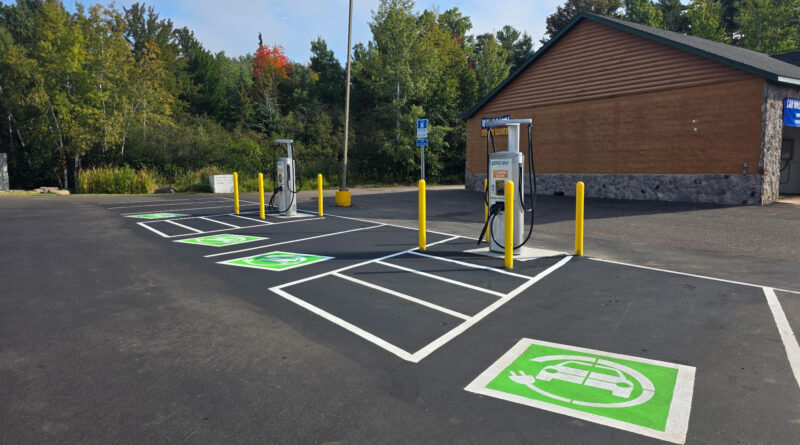
Walmart's in-house DC fast-charging network has expanded to 31 stations with a total of 224 high-power connectors, a 50 percent increase from the 20 stations the company operated as of February 10, 2026. According to InsideEVs, citing Department of Energy Alternative Fuels Data Center records, Walmart added seven new stations in March alone and four more in early April, with Texas now hosting 15 stations, Arizona six, Florida three, Oklahoma two, and Alabama, Arkansas, Georgia, New Jersey, and South Carolina each holding one. The company is using exclusively 400-kilowatt Alpitronic HYC400 or ABB A400 hardware, with each stall fitted with both an NACS connector and a CCS1 port, and the network charges an average of 0.48 dollars per kilowatt-hour with payment and session control through the Walmart smartphone app.
The Walmart deployment is significant for Los Angeles property owners for two distinct reasons. First, Walmart's strategy of deploying 400-kilowatt hardware at every site rather than the legacy 150-kilowatt installations that dominated the earlier wave of DC fast-charger rollouts establishes a new floor for what counts as a competitive site spec, and Los Angeles commercial property owners considering deployments at retail centers, big-box anchors, or hospitality properties should size their electrical service to match. Second, the dual-connector NACS-and-CCS1 configuration confirms that the industry has settled on supporting both standards in parallel for the foreseeable future rather than forcing drivers to carry physical adapters, which simplifies site planning for property owners. Building on the high-power infrastructure themes we covered in our recent post on the Q1 2026 fast-charging report and EVgo's NACS expansion, the practical implication for Los Angeles is that 400-kilowatt-class hardware now requires substantially higher service capacity than legacy fast chargers and typically drives transformer upgrades, new utility service entrances, and LADWP coordination on service panel sizing. Shaffer Construction performs the electrical load studies and utility interconnection work required to determine feasibility for high-power deployments and manages the full LADWP and Department of Building and Safety permitting process from concept through energization.
California DMV Adopts New Heavy-Duty Autonomous Vehicle Rules, Opening Door to Autonomous Freight
The California Department of Motor Vehicles adopted new regulations on April 28 that for the first time allow manufacturers to test and deploy heavy-duty autonomous vehicles on California roads, lifting the prior ban on driverless operation of vehicles weighing more than 10,001 pounds. According to coverage from MarketScreener, the new rules require manufacturers to begin with safety-driver testing and progress to driverless testing before applying for commercial deployment, with mandatory mileage thresholds of 50,000 miles for light-duty vehicles and 500,000 miles for heavy-duty vehicles at each phase of validation. Manufacturers must also prepare a structured safety case documenting the vehicle hardware, software, and operations, provide annual updates to first-responder interaction plans, maintain manual override systems, and operate two-way communication links capable of responding within 30 seconds. Medium-duty autonomous vehicles up to 14,001 pounds will additionally be allowed for operation by public agencies and universities.
The opening of California to autonomous freight has direct implications for Los Angeles charging infrastructure planning because the state's freight corridors converge on the Port of Long Beach, the Inland Empire warehouse cluster, and the major distribution hubs that feed Los Angeles County. Autonomous freight operations require electrified vehicles charged at depot scale, and the depot model in turn requires multi-megawatt service capacity, on-site stationary battery storage, and a level of utility coordination that few existing industrial properties have completed. Building on the truck-charging infrastructure themes we covered in our recent post on EV Realty's 76-port truck hub in San Bernardino and the gas-price-driven EV demand surge, the practical implication for Los Angeles industrial property owners is that the autonomous freight build-out will create durable demand for engineering and construction partners who can deliver depot-scale charging at sites with constrained utility service. Shaffer Construction provides the electrical load studies and full commercial EV charging installation services required to specify, permit, and construct truck-and-fleet-class depots that meet the throughput and uptime expectations of autonomous freight operators.
California Q1 ZEV Market Share Falls to 13.7 Percent as Newsom Pushes $200 Million Rebate
New California Department of Motor Vehicles registration data for Q1 2026 confirms that Tesla registrations dropped 24.3 percent year-over-year to 38,494 units while overall California zero-emission-vehicle registrations fell 40.2 percent to just 57,111 units, dragging total ZEV market share down to 13.7 percent from roughly 21 percent in 2025 and marking the lowest quarterly market share for ZEVs in California since 2021. As reported by Electrek, hybrid registrations climbed to 20.9 percent of the market and gas-only vehicles recovered to 61.1 percent, up from 54 percent in 2025, as the expiration of the federal 7,500-dollar new EV tax credit at the end of September 2025 reset the affordability calculation for many California buyers. Governor Gavin Newsom's response is a 200-million-dollar state ZEV rebate proposal in his 2026 to 2027 budget, which would offer point-of-sale incentives to first-time ZEV buyers on new passenger cars priced at or below 55,000 dollars, vans, SUVs, and pickups priced at or below 80,000 dollars, and used vehicles priced at or below 25,000 dollars, with an automaker-funded dollar-for-dollar match potentially doubling the program's effective scale.
The market data and the Newsom rebate proposal both have implications for Los Angeles charging deployment timing. As reported by InsideEVs, the proposed program needs legislative approval during this spring's budget negotiations, and a CalMatters analysis found that the 200-million-dollar program would cover only roughly one in five California EV sales at expected uptake. Building on the EV pricing-and-incentive dynamics we covered in our post on Ford's Power Promise free-charger program and the surge in used EV sales, the practical implication for Los Angeles property owners is that the federal 30C tax credit for EV charger installation remains the single most generous incentive currently available, and the June 30 expiration date represents a hard deadline regardless of what happens with the Sacramento ZEV vehicle rebate negotiations. Stacking the 30C credit with LADWP's residential and commercial charger rebates remains the most efficient path to lowering the all-in cost of installation. Shaffer Construction handles the full residential EV charger installation process and ensures that every project files the documentation required to capture the available federal, state, and LADWP incentives.
EV Aftermarket Global Business Report Projects $272.5 Billion Market by 2030
Global Industry Analysts published a new EV aftermarket report on April 28 projecting that the global EV aftermarket will grow from 96.4 billion dollars in 2024 to 272.5 billion dollars by 2030, a compound annual growth rate of 18.9 percent driven by an aging on-the-road EV fleet, the maturation of battery-centric maintenance models, and the rise of digital service ecosystems built around connected vehicle telemetry. According to the announcement carried by GlobeNewswire, the underlying drivers include the growing population of EVs that have aged past their original-equipment warranties, the emergence of independent battery diagnostic and refurbishment service providers, and the integration of remote diagnostics, predictive maintenance, and over-the-air software updates into routine service workflows.
The aftermarket projection has direct implications for Los Angeles charging deployment because every EV sold into the local market generates not just a charging requirement but a multi-year service relationship that increasingly depends on the quality of the home or workplace charging environment. Building on the residential charging value-chain themes we covered in our post on why EV charger installations are accelerating and what Los Angeles property owners need to know, the practical implication is that residential and commercial chargers are no longer simply hardware installations but components in an emerging service-and-data ecosystem where smart charger telemetry feeds maintenance scheduling, utility load management, and incentive enrollment. Los Angeles homeowners and property managers should specify networked Level 2 chargers that are eligible for LADWP rebates and compatible with utility managed-charging programs to position their properties to participate in the larger service economy. Shaffer Construction installs networked Level 2 hardware that meets LADWP qualifying-product-list requirements and integrates with utility managed-charging programs.
Ford Mustang Cobra Jet 2200 Sets New EV Quarter-Mile World Record at 6.87 Seconds
Ford Racing's new Mustang Cobra Jet 2200 set a new electric vehicle quarter-mile world record on April 26 at the NHRA 4-Wide Nationals in Charlotte, running 6.87 seconds at 221 miles per hour and demolishing Ford's prior EV record of 7.623 seconds set in September 2024. As reported by Electrek, the Cobra Jet 2200 program continues Ford's 60-year heritage of factory drag-racing experimental vehicles and is the company's most powerful purpose-built electric race car to date. The 2200 designation reflects the vehicle's 2,200-horsepower peak output, and the platform serves as a test bed for inverter electronics, motor cooling, and high-discharge battery pack design that are expected to inform future production vehicles in the Ford performance lineup.
The Cobra Jet record matters for Los Angeles property owners because it confirms that EV drivetrain technology has matured well past the early-adopter phase and is now setting absolute performance benchmarks that gasoline-engine alternatives cannot match. Building on the residential and commercial charging readiness themes we covered in our post on our ultimate guide to home EV charger installation in Los Angeles, the practical implication for Los Angeles homeowners considering an EV purchase is that the performance landscape now favors electric vehicles in nearly every segment from compact crossovers through luxury sports cars, which is reshaping the consumer purchase calculus and continuing to drive Level 2 charger demand. Shaffer Construction handles the full residential EV charger installation scope including main-panel evaluations, NEC 2023 load calculations, dedicated 240-volt circuit installation, and permit submission to the Los Angeles Department of Building and Safety.
Conclusion
The news cycle of April 29, 2026 lays out a market that is rebalancing on multiple axes simultaneously. Walmart's 31-station, 224-stall DC fast-charging deployment confirms that the industry has settled on 400-kilowatt dual-connector hardware as the new competitive baseline. The California DMV's adoption of heavy-duty autonomous vehicle rules opens the door to autonomous freight operations and the depot-scale charging infrastructure that those operations will require. New Q1 California registration data shows the state's ZEV market share at a four-year low, but Governor Newsom's 200-million-dollar rebate proposal is one piece of a broader incentive architecture that still works in favor of EV adoption when stacked with the federal 30C tax credit and LADWP rebates. The Global Industry Analysts EV aftermarket report projects the service-and-maintenance economy around electric vehicles to nearly triple by 2030, reinforcing that residential and commercial chargers are now part of an integrated service ecosystem rather than standalone hardware. And Ford's new EV quarter-mile world record demonstrates that electric drivetrain performance has crossed the threshold where gasoline alternatives are no longer competitive in any meaningful performance dimension. For Los Angeles property owners, the cumulative signal is clear: the charging infrastructure investments made between now and June 30 will determine which properties are positioned to capture the value of the next wave of vehicle deliveries, fleet conversions, autonomous freight, and aftermarket service relationships.
Ready to install EV charging infrastructure before the federal 30C tax credit expires on June 30, 2026? Shaffer Construction, Inc. provides expert design, permitting, and installation services for residential and commercial charging systems, electrical load studies, and complete project management that helps Los Angeles property owners capture every available federal, state, and LADWP incentive before their respective deadlines.
Shaffer Construction, Inc.
325 N Larchmont Blvd. #202
Los Angeles, CA 90004
Phone: (323) 642-8509
Email: hello@shaffercon.com
Website: shaffercon.com