
Tesla Launches Supercharger for Business as US DC Fast Charging Hits Record 65,000 Stalls
Introduction
The American EV charging landscape continues its remarkable transformation, with record infrastructure deployment, innovative business models, and shifting consumer behavior reshaping how property owners approach electric vehicle readiness. At Shaffer Construction, Inc., we track these developments to help Los Angeles property owners make strategic decisions about their commercial EV charger installations and residential charging solutions. This week brings particularly significant news, from Tesla's groundbreaking third-party ownership program to record fast charging deployment and the rapid evolution of gas stations into EV charging destinations.
Tesla Launches First Third-Party Owned Supercharger in North America
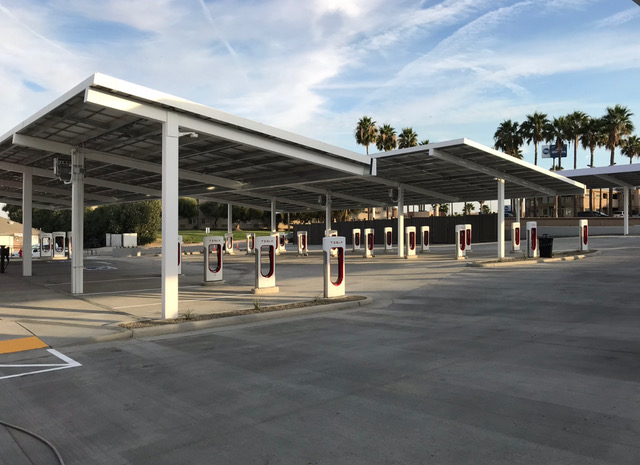
Tesla has officially opened its first North American Supercharger owned by a third party, marking a fundamental shift in how the world's largest fast charging network will expand going forward. The eight-stall station opened on November 20, 2025 in Land O' Lakes, Florida, featuring Tesla's latest V4 Supercharging technology capable of delivering up to 325 kilowatts. Unlike Tesla's 75,000-plus existing Superchargers, which the company funds and operates entirely in-house, this station was purchased by Suncoast Credit Union through Tesla's new Supercharger for Business program. Source: Electrek.
The program represents a clever solution to scaling EV infrastructure more rapidly. Property owners purchase the hardware and pay for installation while Tesla handles all ongoing operations, including network management, preventative maintenance, driver support, and billing. Tesla guarantees 97% uptime, described as the highest in the industry, while the business owner benefits from customer traffic and visibility without needing any charging expertise. Notably, these Superchargers display the business owner's branding rather than Tesla's, though they remain fully integrated into the Tesla network and accessible to all NACS-compatible vehicles. Source: Teslarati.
For commercial property owners in Los Angeles, this development signals new possibilities for EV infrastructure investment. While the Supercharger for Business program currently requires significant capital and may be most attractive to businesses with high traffic locations, the model demonstrates that third-party ownership of professionally managed charging infrastructure is viable. As we discussed in our guide to EV charger installations in 2025, properties that invest in charging infrastructure now capture growing EV driver demand while positioning themselves ahead of competitors. Shaffer Construction helps commercial clients evaluate their options and design installations that align with business objectives, whether that means installing Level 2 chargers for employee or customer use or deploying DC fast charging for high-turnover retail locations.
US DC Fast Charging Network Surpasses 65,000 Public Stalls
The United States now has more than 65,000 public DC fast charging ports, a milestone that reflects the accelerating pace of infrastructure deployment in 2025. As of November 10, 2025, the total stood at 65,447 ports across all connector standards, representing an increase of over 5,000 stalls since late July and approximately 14,500 since January 1. The network is currently adding roughly 45 new fast charging stalls per day, putting the country on track to add 16,700 public fast charging ports by year's end, about 2.4 times the number added in 2022. Source: EV Charging Stations.
Tesla's Supercharger network remains the largest with over 34,700 stalls and a 53% market share, though this percentage has declined from 57% at the beginning of 2025 as competitors expand aggressively. Electrify America, EVgo, and ChargePoint each maintain between 4,375 and 5,228 ports, making them relatively comparable in size. The three networks recently signed interoperability agreements allowing drivers to charge across all three with a single account, simplifying the charging experience for non-Tesla drivers. If current deployment rates continue, the United States will reach 100,000 public fast charging ports by 2027.
This infrastructure expansion directly benefits Los Angeles property owners considering EV charging investments. The growing network makes EV ownership increasingly practical for more drivers, which translates to increased demand for workplace, retail, and residential charging. Commercial properties that offer charging attract the growing population of EV drivers seeking convenient places to charge while shopping, working, or dining. Shaffer Construction performs thorough electrical load studies to help property owners understand their current capacity and plan installations that deliver reliable service as demand grows.
Gas Stations Transform Into EV Charging Destinations
Traditional fuel retailers are rapidly expanding into EV charging, with convenience store chains Wawa and Sheetz leading the transformation. According to a Consumer Reports analysis of 75 major retailers, these two chains have installed EV chargers at between 11% and 30% of their locations, averaging six to ten fast chargers per site. Wawa has deployed more than 210 chargers, while Sheetz provides over 650 chargers across 95 locations that have logged more than 2 million charging sessions. Major truck stop chains including Love's Travel Stops, Pilot Flying J, and Buc-ee's are following suit. Source: Grist.
Wawa recently announced a partnership with IONNA, the EV charging network founded by eight major automakers, to install high-speed charging stations called Rechargeries at multiple locations. The first Wawa Rechargery opened in Daytona Beach, Florida, with additional sites under construction in Bradenton, Pensacola, and Orlando. Pennsylvania's Department of Transportation has allocated over $6 million for EV charging stations at 12 Sheetz locations and approximately $4 million for charging stations at nine Wawa locations, funded through the federal NEVI program. Source: CSP Daily News.
The shift reflects a fundamental change in the economics of fuel retailing. As more retailers offer charging, competition will increasingly focus on the quality of the charging experience rather than simply the price. Drivers who spend 15 to 30 minutes charging represent valuable customers for food, beverages, and convenience items. This creates opportunities for Los Angeles retail property owners to capture similar benefits by adding charging amenities. Restaurants, shopping centers, and entertainment venues can transform charging time into shopping and dining time. Shaffer Construction works with retail clients throughout Los Angeles to design charging installations that complement business operations while meeting the practical needs of EV drivers.
ChargePoint Wins Contract for Public Sector EV Charging
ChargePoint was awarded a Sourcewell cooperative purchasing contract on November 25, 2025 to provide EV charging solutions to public sector agencies across the United States and Canada. Sourcewell's purchasing network includes more than 50,000 participating agencies, enabling government, educational, and nonprofit organizations to procure products through a streamlined process with preferred pricing. The contract positions ChargePoint to accelerate EV charging deployment at schools, municipal buildings, and public facilities nationwide. Source: Charged EVs.
The same week, a metro Detroit real estate developer announced plans to deploy more than 40 ChargePoint DC fast charging ports across its properties, targeting areas characterized as EV charging deserts. The initiative, launched by Dabaja Brothers Development Group, has already installed its first station in Canton, Michigan with additional sites planned in Dearborn and Lavonia. These developments underscore ChargePoint's strategy of expanding through partnerships with property owners and institutions rather than building and operating stations directly.
Public sector adoption of EV charging has direct implications for property owners who serve government tenants or operate near public facilities. As municipalities and school districts deploy charging infrastructure, surrounding properties may see increased EV traffic and corresponding demand for additional charging options. The public sector also serves as a proving ground for charging technologies and business models that eventually spread to commercial applications. Understanding these trends helps property owners plan investments that remain competitive as the market evolves. Shaffer Construction advises clients on equipment selection and network options, helping them make informed decisions that balance current needs with future flexibility.
California Maintains National Leadership with Over Two Million EVs
California continues to dominate national EV adoption, with over two million registered electric vehicles representing 5.8% of all vehicles in operation statewide. The state now has 48% more EV chargers than gas station nozzles, a striking milestone that reflects the depth of infrastructure investment over the past decade. Californians purchased nearly 100,326 zero-emission vehicles in the first quarter of 2025 alone, with EVs accounting for 23% of new vehicle sales. Almost 50% of California's charging infrastructure funding has been directed to low-income and underserved communities to ensure broad access to clean transportation benefits. Source: ABC17.
California's leadership stems from multiple factors, including the Clean Air Act provisions allowing the state to set stricter emissions standards, a long history of EV incentives, dense urban markets that benefit from reduced range anxiety, and regulatory mandates requiring automakers to increase zero-emission vehicle offerings. The state's 2025 Advanced Clean Cars rules require manufacturers to steadily increase EV sales, with the goal of 100% zero-emission vehicle sales by 2035. Six additional states have adopted similar mandates starting in 2026, with six more scheduled for the 2027 model year.
For Los Angeles property owners, these statistics translate directly to market opportunity. With nearly one in four new cars sold being electric, the pool of EV drivers seeking charging access grows larger every month. Properties without charging capabilities face increasing competitive disadvantage, whether competing for tenants, customers, or buyers. As we detailed in our ultimate guide to home EV charger installation, there are multiple pathways to providing charging access depending on property type and electrical capacity. Many homeowners find that panel upgrades may be necessary to support EV charging alongside existing electrical demands, and addressing this proactively ensures a smooth installation process.
What These Developments Mean for Los Angeles Property Owners
This week's news reinforces several important themes for property owners considering EV infrastructure investments. Tesla's Supercharger for Business program demonstrates that professionally managed, third-party owned charging is now viable at scale, expanding options for commercial properties with high traffic potential. The record pace of US fast charging deployment, now exceeding 65,000 stalls with 45 new additions daily, validates the market demand that drives these investments. Gas station chains transforming into EV charging destinations show how retail businesses are capturing value from the transition, a model adaptable to restaurants, shopping centers, and entertainment venues.
California's position as the national EV leader, with more chargers than gas nozzles and over two million EVs on the road, means Los Angeles property owners operate in the most competitive and opportunity-rich market in the country. The combination of regulatory mandates pushing automakers toward 100% EV sales and infrastructure investment exceeding anything seen in other states creates an environment where EV readiness is rapidly becoming essential rather than optional.
The time to invest in EV charging infrastructure is now, while incentive programs remain available and before contractor availability becomes constrained. Professional installation ensures your investment performs reliably, passes inspection on the first attempt, and complies with all applicable codes including California Title 24 requirements. Shaffer Construction brings decades of electrical expertise to every project, from initial load analysis through final commissioning and ongoing support.
Conclusion
From Tesla's groundbreaking Supercharger for Business program to the milestone of 65,000 US DC fast charging stalls, this week's developments demonstrate the accelerating maturity of EV infrastructure. Gas stations are transforming into charging destinations, public sector adoption is expanding through streamlined procurement, and California continues leading the nation with over two million EVs and more chargers than gas nozzles. These trends collectively make the case for property owners to act now on EV charging infrastructure while positioning remains advantageous and incentives remain available.
Ready to explore EV charging options for your Los Angeles property? Contact Shaffer Construction, Inc. for a complimentary site assessment and expert guidance on the right charging solution for your needs.
Shaffer Construction, Inc.
325 N Larchmont Blvd. #202
Los Angeles, CA 90004
Phone: (323) 642-8509
Email: hello@shaffercon.com
Website: www.shaffercon.com