Indiana Debuts First U.S. Wireless Highway Charging as BMW Gains Supercharger Access and Walmart Expands Network
Introduction
As 2025 closes, the EV charging landscape sees breakthrough technology demonstrations alongside continued network expansion. Indiana achieved the first successful U.S. highway wireless charging test at 190 kilowatts, BMW owners gained access to 25,000 Tesla Superchargers, and Walmart's emerging charging network reached 16 locations with 31 more coming soon. At Shaffer Construction, Inc., we track these developments to help Los Angeles property owners understand the evolving charging infrastructure and make informed decisions about their commercial EV charger installations and residential charging solutions. This Monday we examine wireless charging breakthroughs, network access expansion, and retail charging growth shaping the start of 2026.
Indiana Achieves First U.S. Highway Wireless EV Charging at 190 Kilowatts
For the first time in the United States, a roadway has wirelessly charged an electric heavy-duty truck driving at highway speeds. Purdue University engineers demonstrated their patent-pending wireless charging system on December 6, 2025, delivering 190 kilowatts to a Cummins electric semitractor traveling at 65 miles per hour on a quarter-mile segment of U.S. Highway 52/231 in West Lafayette, Indiana. The Indiana Department of Transportation embedded Purdue-designed charging coils beneath the concrete highway pavement. Source: Purdue University.
The 11 million dollar state-funded project represents a significant step toward electrifying freight transportation. According to Steve Pekarek, Purdue's Edmund O. Schweitzer III Professor of Electrical and Computer Engineering, 200 kilowatts is on the scale of about a hundred homes. The Purdue-designed system accommodates a wide power range, allowing a single receiver coil assembly placed under the tractor rather than multiple low-power coils on the trailer. This simplification makes the technology more practical for commercial deployment.
The implications for heavy-duty trucking are substantial. Since trucking contributes the most to U.S. gross domestic product compared to other freight modes, wireless highway charging could allow electric trucks to carry smaller batteries and more cargo. As we noted in our coverage of the U.S. DC fast charging network surpassing 65,000 stalls, infrastructure innovation continues accelerating EV adoption across all vehicle categories.
BMW Electric Vehicles Gain Access to 25,000 Tesla Superchargers
Tesla added BMW as the 15th automaker to gain Supercharger Network access in 2025, effective December 10. The expansion adds more than 2,000 Tesla stations and over 25,000 Superchargers to BMW's available charging network, immediately boosting fast-charging options for current BMW EV owners. Current-generation BMW EVs including the i4, i5, i7, and iX can charge using a CCS-to-NACS DC adapter, with BMW's Plug and Charge function now working at Tesla Superchargers for automatic session initiation. Source: Teslarati.
BMW joins a growing list of automakers embracing Tesla's Supercharger Network, which remains the largest in the U.S. with over 34,700 stalls and 53 percent market share. The network effect benefits all EV drivers as more vehicles can access the most extensive fast-charging infrastructure. Future BMW models will include native NACS ports, eliminating the need for adapters and further streamlining the charging experience.
For Los Angeles property owners, the expanding Supercharger access means BMW drivers increasingly expect charging availability as a standard amenity. Properties that offer Level 2 charging complement the fast-charging network by providing convenient overnight and workplace charging. As we discussed in our 2025 year-end review, premium EV brands like BMW, Lucid, and Rivian attract affluent buyers who value properties with charging infrastructure.
Walmart Expands Charging Network to 16 Locations with 31 More Coming
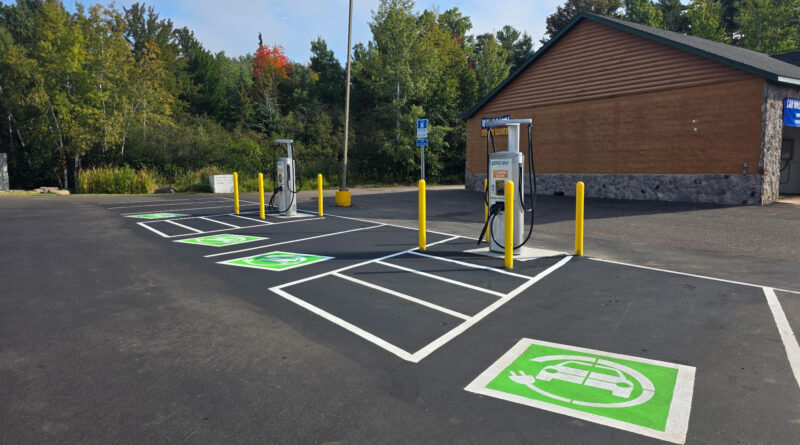
Walmart's emerging DC fast-charging network closes out 2025 with approximately 16 operational locations and 31 more listed as coming soon on its website. The retailer has installed both Alpitronic HYC400 and ABB A400 chargers offering peak power of 400 kilowatts, with both CCS1 and NACS connectors for maximum vehicle compatibility. Current locations span Arkansas, Oklahoma, Texas, Arizona, and Florida, with Texas serving as the primary expansion market with about 10 live sites. Source: EV Charging Stations.
The upcoming 31 locations include 10 in Arizona, 11 in Texas, two in Oklahoma, one in Georgia, two in Utah, and five in Arkansas. Permit filings reveal 219 known planned locations with new discoveries occurring almost daily. By 2030, Walmart intends to build its own EV fast-charging network at thousands of Walmart and Sam's Club locations coast-to-coast, potentially doubling the number of DC fast chargers in the U.S. by decade's end. Source: Walmart Corporate.
With a store or club located within 10 miles of approximately 90 percent of Americans, Walmart is uniquely positioned to deliver convenient charging access. For property owners, Walmart's entry into charging demonstrates that major retailers recognize EV infrastructure as essential customer amenity. Properties that install charging now position themselves alongside national retailers investing heavily in the EV transition.
Tesla Introduces 3D Supercharger Site Maps for Easier Navigation
Tesla unveiled a new 3D render feature that displays precise Supercharger stall locations as drivers approach stations. The innovative visualization helps drivers identify open spots at larger and busier sites, reducing stress and improving the charging experience. Tesla's director of charging, Max de Zegher, stated the feature should make Supercharging a little more magical, especially at larger and busy sites. The feature is currently available at 18 Supercharger stations. Source: Not A Tesla App.
Tesla is also rolling out centralized payment kiosks at new V4 Supercharger stations, replacing individual credit card terminals with a single standalone hub serving the entire cluster of chargers. The first branded Supercharger for Business location opened in Land O' Lakes, Florida, featuring eight V4 Supercharging stalls offering up to 325 kilowatts. This program allows third-party companies to brand their own charging stations while leveraging Tesla's proven technology and network.
Tesla's continued innovation in both hardware and software demonstrates the company's commitment to improving charging experience alongside expanding capacity. As we covered in our analysis of California surpassing 200,000 EV chargers, the quality of charging experience matters as much as quantity in driving EV adoption.
Stellantis to Add Native Supercharger Access for Jeep and Dodge EVs in 2026
Stellantis announced that the Jeep Wagoneer S and Dodge Charger Daytona will adopt the North American Charging Standard and gain native Tesla Supercharger access without adapters starting in 2026. The expansion adds over 20,000 additional charging stations to these vehicles' available network in North America. The move follows the industry-wide adoption of NACS as the unified charging standard, simplifying the charging experience for all EV drivers. Source: The Cool Down.
The transition to NACS represents a fundamental shift in U.S. charging infrastructure standardization. Rather than maintaining multiple connector types, the industry is coalescing around Tesla's proven connector design. This standardization benefits property owners installing charging infrastructure, as NACS-equipped stations will serve the widest possible range of vehicles in coming years.
For commercial and residential property owners, the Stellantis announcement confirms that American-brand electric vehicles will increasingly use the Supercharger network for fast charging while relying on property-based Level 2 charging for daily needs. Shaffer Construction helps property owners select charging equipment compatible with evolving standards through comprehensive electrical load studies that plan for current and future vehicle requirements.
What These Developments Mean for Los Angeles Property Owners
This Monday's developments showcase both breakthrough technology and practical network expansion. Indiana's wireless highway charging demonstration at 190 kilowatts proves that in-road charging technology works at commercial scales, potentially transforming freight transportation over the coming decade. While wireless highway charging remains years from widespread deployment, the successful test validates the technology direction.
More immediately relevant, BMW's addition to the Tesla Supercharger Network and Stellantis's upcoming NACS adoption continue expanding the vehicles that can access the nation's largest fast-charging infrastructure. Walmart's aggressive entry into DC fast charging with 400-kilowatt stations at hundreds of planned locations signals that major retailers view EV infrastructure as essential to remaining competitive.
For Los Angeles property owners, these network expansions reinforce the value of on-site charging. Fast-charging networks handle road trips and quick top-ups, while property-based Level 2 charging serves daily needs. Properties with charging infrastructure attract the growing population of EV drivers who expect convenient overnight and workplace charging availability.
Conclusion
As 2025 closes, EV charging infrastructure advances on multiple fronts. Indiana's wireless highway charging breakthrough demonstrates technology that could eventually eliminate the need for stationary charging stops on long-haul routes. BMW and Stellantis joining the Supercharger ecosystem brings millions more vehicles to the nation's largest fast-charging network. Walmart's expansion to 16 locations with hundreds more planned signals that retail charging is becoming standard. For Los Angeles property owners, these developments underscore the strategic importance of installing charging infrastructure while utility rebate programs remain available and before mainstream EV adoption creates surge demand for charging access. Properties that act now position themselves to serve the expanding EV population entering 2026.
Ready to explore EV charging options for your Los Angeles property? Contact Shaffer Construction, Inc. for a complimentary site assessment and expert guidance on selecting the right charging solution for your needs.
Shaffer Construction, Inc.
325 N Larchmont Blvd. #202
Los Angeles, CA 90004
Phone: (323) 642-8509
Email: hello@shaffercon.com
Website: www.shaffercon.com